
Richard Blanco
Illuminating Poetry for Everyone
Looking for The Gulf Motel
University Pittsburgh Press, 2012
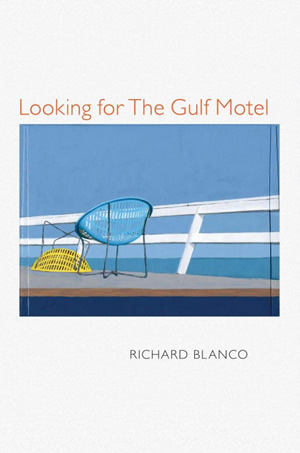
*Winner of the Paterson Prize, the Thom Gunn Award, and a Maine Literary Award.
A genealogy of the heart tracing the emotional legacy Blanco’s family has shaped—and continues shaping—his Latino identity, sexual identity, and understanding of the big questions of life and death.
Family continues to be a wellspring of inspiration and learning for Blanco. His third book of poetry, Looking for The Gulf Motel, is a genealogy of the heart, exploring how his family’s emotional legacy has shaped—and continues shaping—his perspectives. The collection is presented in three movements, each one chronicling his understanding of a particular facet of life from childhood into adulthood. As a child born into the milieu of his Cuban exiled familia, the first movement delves into early questions of cultural identity and their evolution into his unrelenting sense of displacement and quest for the elusive meaning of home. The second, begins with poems peering back into family again, examining the blurred lines of gender, the frailty of his father-son relationship, and the intersection of his cultural and sexual identities as a Cuban-American gay man living in rural Maine. In the last movement, poems focused on his mother’s life shaped by exile, his father’s death, and the passing of a generation of relatives, all provide lessons about his own impermanence in the world and the permanence of loss. Looking for the Gulf Motel is looking for the beauty of that which we cannot hold onto, be it country, family, or love.
Read Excerpts
Looking for the Gulf Motel (title poem)
Marco Island, Florida
There should be nothing here I don’t remember . . .
The Gulf Motel with mermaid lampposts
and ship’s wheel in the lobby should still be
rising out of the sand like a cake decoration.
My brother and I should still be pretending
we don’t know our parents, embarrassing us
as they roll the luggage cart past the front desk
loaded with our scruffy suitcases, two-dozen
loaves of Cuban bread, brown bags bulging
with enough mangos to last the entire week,
our espresso pot, the pressure cooker—and
a pork roast reeking garlic through the lobby.
All because we can’t afford to eat out, not even
on vacation? Only two hours from our home
in Miami, but far enough away to be thrilled
by whiter sands on the west coast of Florida,
where I should still be for the first time watching
the sun set instead of rise over the ocean.
There should be nothing here I don’t remember . . .
My mother should still be in the kitchenette
of The Gulf Motel, her daisy sandals from Kmart
still squeaking across the linoleum, still gorgeous
in her teal swimsuit and amber earrings
stirring a pot of arroz con pollo, adding sprinkles
of onion powder and dollops of tomato sauce.
My father should still be in a terrycloth jacket
smoking, clinking a glass of amber whiskey
in the sunset at The Gulf Motel, watching us
dive into the pool, two sons he’ll never see
grow into men who will be proud of him.
There should be nothing here I don’t remember . . .
My brother and I should still be playing Parcheesi,
my father should still be alive, slow dancing
with my mother on the sliding-glass balcony
of The Gulf Motel. No music, only the waves
keeping time, a song only their minds hear
ten thousand nights back to their life in Cuba.
My mother’s face should still be resting against
his bare chest like the moon resting on the sea,
the stars should still be turning around them.
There should be nothing here I don’t remember . . .
My brother should still be thirteen, sneaking
rum in the bathroom, sculpting naked women
from sand. I should still be eight years old
dazzled by seashells and how many seconds
I hold my breath underwater—but I’m not—
I am thirty-eight, driving up Collier Boulevard,
looking for The Gulf Motel, for everything
that should still be, but isn’t. I want to blame
the condos, their shadows, for ruining the beach,
and my past, I want to chase the snowbirds away
with their tacky mansions and yachts, I want
to turn the golf courses back into mangroves.
I want to find The Gulf Motel exactly as it was
and pretend for a moment, nothing lost is lost.
Since Unfinished
I’ve been writing this since
the summer my grandfather
taught me how to hold a blade
of grass between my thumbs
and make it whistle, since
I first learned to make green
from blue and yellow, turned
paper into snowflakes, believed
a seashell echoed the sea,
and the sea had no end.
I’ve been writing this since
a sparrow flew into my class
and crashed into the window,
laid to rest on a bed of tissue
in a shoebox by the swings, since
the morning I first stood up
on the bathroom sink to watch
my father shave, since our eyes
met in that foggy mirror, since
the splinter my mother pulled
from my thumb, kissed my blood.
I’ve been writing this since
the woman I slept with the night
of my father’s wake, since
my grandmother first called me
a faggot and I said nothing, since
I forgave her and my body
pressed hard against Michael
on the dance floor at Twist, since
the years spent with a martini
and men I knew couldn’t love.
I’ve been writing this since
the night I pulled off the road
at Big Sur and my eyes caught
the insanity of the stars, since
the months by the kitchen window
watching the snow come down
like fallout from a despair I had
no word for, since I stopped
searching for a name and found
myself tick-tock in a hammock
asking nothing of the sky.
I’ve been writing this since
spring, studying the tiny leaves
on the oaks dithering like moths,
contrast to the eon-old fieldstones
unveiled of snow, but forever
works-in-progress, since tonight
with the battled moon behind
the branches spying on the world—
same as it ever was—perfectly
unfinished, my glasses and pen
at rest again on the night table.
I’ve been writing this since
my eyes started seeing less,
my knees aching more, since
I began picking up twigs, feathers,
and pretty rocks for no reason
collecting on the porch where
I sit to read and watch the sunset
like my grandfather did every day,
remembering him and how
to make a blade of grass whistle.
Maybe
Put very simply, this is about that which almost was, what could have been, the one that got away. . .
for Craig
Maybe it was the billboards promising
paradise, maybe those fifty-nine miles
with your hand in mine, maybe my sexy
roadster, top down, the wind fingering
your hair, the sunlight on your thighs
and bare chest, maybe it was just the ride
over the sea split in two by the highway
to Key Largo, or the idea of Key Largo.
Maybe I was finally in the right place
at the right time with the right person.
Maybe there’d finally be a house, a dog
named Chu, a lawn to mow, neighbors,
dinner parties, and you, forever obsessed
with crossword puzzles and Carl Jung,
reading in the dark by the moonlight,
at my bedside every night. Maybe. Maybe
it was the clouds paused at the horizon,
the blinding fields of golden sawgrass,
the mangrove islands tangled, inseparable
as we might be. Maybe I should’ve said
something, promised you something,
asked you to stay a while. Maybe.
El Florida Room
I feel fortunate that my mother still lives in the same house where I grew up in Miami. I can still visit “my house” and travel back in time; I can “go home” whenever I want. Of course the physical appearance of the house–the furniture, drapes, etc., has changed throughout the years. But the feeling remains the same, especially in that one special room–The Florida Room–that was, and continues to be, the center of so many family memories.
Not a study or a den, but El Florida
as my mother called it, a pretty name
for the room with the prettiest view
of the lipstick-red hibiscus puckered up
against the windows, the tepid breeze
laden with the brown-sugar scent
of loquats drifting in from the yard.
Not a sunroom, but where the sun
both rose and set, all day the shadows
of banana trees fan-dancing across
the floor, and if it rained, it rained
the loudest, like marbles plunking
across the roof under constant threat
of coconuts ready to fall from the sky.
Not a sitting room, but El Florida, where
I sat alone for hours with butterflies
frozen on the polyester curtains
and faces of Lladró figurines: sad angels,
clowns, and princesses with eyes glazed
blue and gray, gazing from behind
the glass doors of the wall cabinet.
Not a TV room, but where I watched
Creature Feature as a boy, clinging
to my brother, safe from vampires
in the same sofa where I fell in love
with Clint Eastwood and my abuelo
watching westerns, or pitying women
crying in telenovelas with my abuela.
Not a family room, but the room where
my father twirled his hair while listening
to eight-tracks of Elvis, read Nietzsche
and Kant a few months before he died,
where my mother learned to dance alone
as she swept, and I learned salsa pressed
against my Tía Julia’s enormous hips.
At the edge of the city, in the company
of crickets, beside the empty clothesline,
telephone wires, and the moon, tonight
my life sits with me like an old friend
not in the living room, but in the light
of El Florida, as quiet and necessary
as any star shining above it.
Praise & Reviews
“W. H. Auden, asked to define poetry from the other written arts, wrote that poetry was ‘memorable speech.’ Richard Blanco’s speech invites the reader in with its search for home. His lyrics open doors onto his Cuban immigrant family, his father’s early death, and his own migration from a life in Florida to a life in Maine. His speech houses a generous love of others and a persistent reach for what is absent. There is nothing here you will not remember.
– Spencer Reece
“Every poem in Looking for The Gulf Motel packs an emotional wallop and an intellectual caress. A virtuoso of art and craft who juggles the subjective and the objective beautifully, Blanco is at the height of his creative prowess and one of the best of the best poets writing today.
– Jim Elledge
“The poems in Looking for The Gulf Motel are bittersweet songs that ache with the ‘sweet and slow honey of a bolero.’ They croon about journeys from Cuba and Spain to Florida and Maine; mourn languages, lovers, and names that were or could have been; and praise the forgotten pop culture icons that expanded one young person’s view of his nationality and manhood. If all loss is like exile, Blanco tells us, then searching for love (in the self, in others) is healing, is finding home, because ‘love is thicker than any country.
– Rigoberto González
“I was so moved by Richard Blanco’s One Today: A Poem for Barack Obama’s Presidential Inauguration that I immediately dug into and recently re-read (because it’s that good) Blanco’s Looking for The Gulf Motel, a moving collection of poetry by an artist who was the youngest, first Latino and first openly gay person to serve as an inaugural poet.
– Lynn Yoffee – BioWorld Executive Editor
“The main thing about Blanco’s poems is how lyrical his voice is and how universal his themes, how easily we can relate to his concerns.”
– Chamber Four
“These are poems of poetic beauty and heart, confession and acceptance, courage and love. Wonderful.”
– Synecdoche